Research · UC Irvine · Lee Nano-Optics Lab
Generative design, checked by physics.
Physics-Validated Generative AI for Freeform Optical Metasurface Design. A conditional VAE proposes patterns; RCWA tests whether they steer light toward the target.
Dataset in poster10,000 simulated designs9,000 training / 1,000 validation
Optical targets380–750 nm · 25–75°200 nm TiO₂ layer
Representation160 × 64 DCT coefficients256-dimensional latent vector
Matched fine-tuning evaluation
Better average efficiency.
Mixed best-candidate gains.
These are optical simulation results from the supplied poster. Average gains and best-candidate gains answer different questions; neither demonstrates fabricated-device performance.
01 / METHOD
From optical target to a binary pattern.
Build the design library
Optimize patterns with electromagnetic simulations, then save geometry, optical conditions, and efficiency labels. The poster covers visible wavelengths and steering angles from 25 to 75 degrees.
Learn a conditional representation
The cVAE reconstructs DCT coefficients through a 256-dimensional latent space. Efficiency labels, wavelength, angle, and cell size condition the model; latent sampling produces multiple candidate geometries.
Recover and evaluate
Recover binary patterns and evaluate target-order (+1,0) transmission with RCWA. Efficiency is target-beam power divided by incoming power, averaged over two input polarizations. Simulated binary-pattern efficiency supplies fine-tuning feedback.
02 / COMPARISON
Compare the same optical targets.
Best of 1,000 AI candidates versus an optimized baseline, using matched optical targets and RCWA settings. Values below reproduce the poster labels; deltas are reported in percentage points.
| Target | Baseline | Best AI | Δ (poster) |
|---|---|---|---|
| 446.1 nm / 35.3° | 76.72% | 76.19% | −0.530 pp |
| 548.4 nm / 48.9° | 68.61% | 68.30% | −0.318 pp |
| 650.7 nm / 70.7° | 29.22% | 29.68% | +0.460 pp |
Two of the three comparisons fall below the optimized baseline; one improves by 0.460 pp. The result supports rapid proposal and screening of candidates, with no uniform superiority claim.
The poster reports about 3 seconds to decode 1,000 candidates on an A100, excluding screening. Its estimated 1,192× time ratio uses differing targets, hardware, and RCWA settings. It is not a matched end-to-end speedup benchmark. Fabrication constraints and matched runtime tests remain future work.
03 / RESEARCH ARTIFACT
The complete poster.
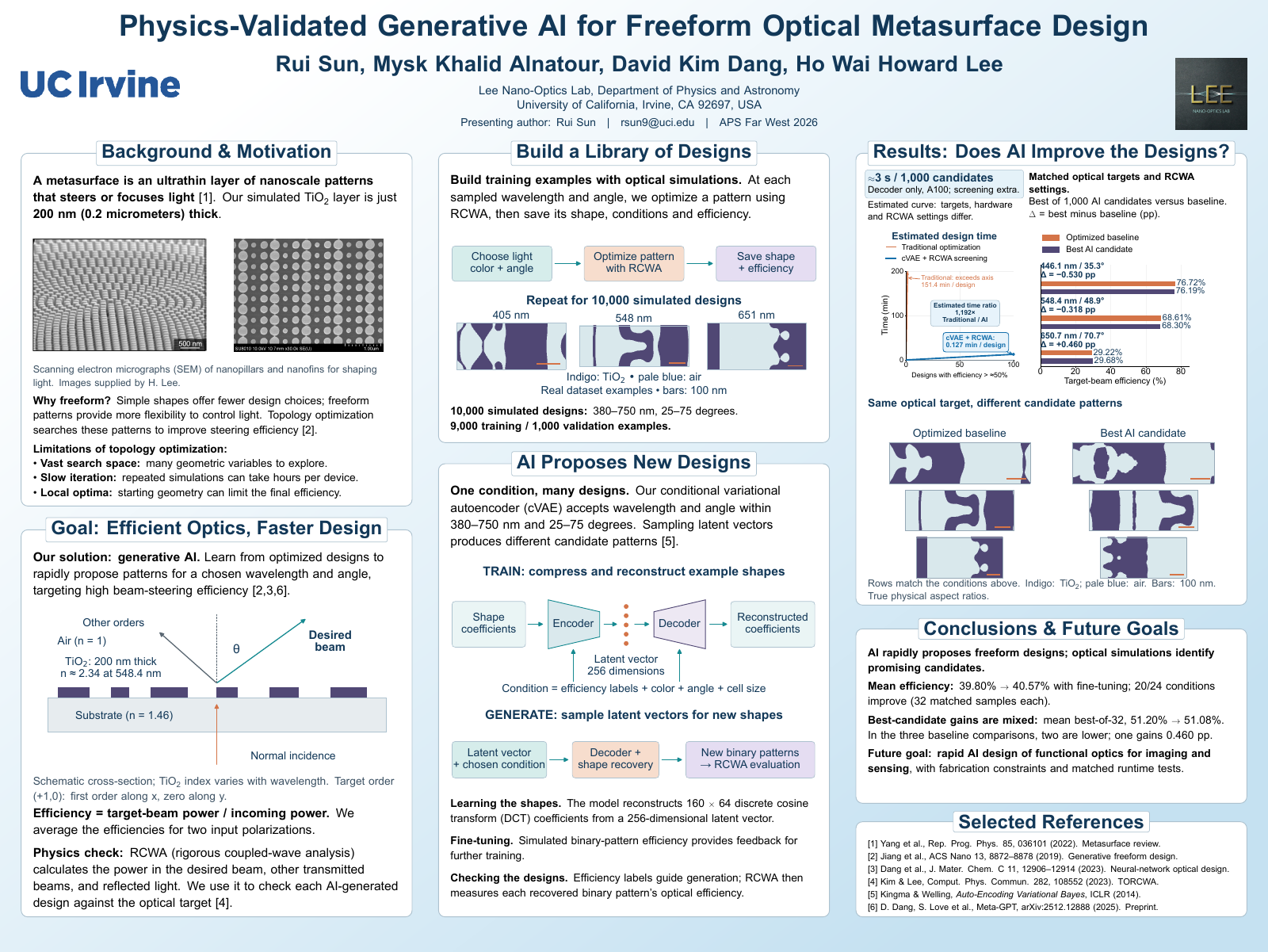
Source: supplied APS Far West 2026 poster. Authors: Rui Sun, Mysk Khalid Alnatour, David Kim Dang, Ho Wai Howard Lee. Research at the Lee Nano-Optics Lab, UC Irvine.