Selected work
From an idea to a working system.
Four projects connecting applied mathematics, AI engineering, and careful evaluation. Each case study explains the problem, my contribution, and what the available evidence supports.
ProofRound
Can a candidate explain and defend the work behind every résumé claim?
Connecting résumé claims to project evidence, then turning the gaps into focused interview preparation.
My contribution
Built workflows for evidence-grounded résumé auditing, adaptive text interviews, transcript-cited feedback, and voice practice. Connected structured AI outputs to validation and saved preparation history.
Technical approach
Map claims to submitted artifacts, distinguish supported claims from missing evidence, and ask follow-up questions grounded in that context. Keep feedback traceable to sources and the actual interview transcript.
What the work demonstrates
- Claim-to-evidence mapping with source citations
- Adaptive text and voice practice workflows
- Transcript-grounded feedback and preparation history
A working AI product with ongoing development. Feature availability depends on account and configuration; no claim of improved hiring outcomes is made.
Visit ProofRound ↗Nepholio
How can nutrition tracking stay useful when portions, source data, and daily records are incomplete?
A daily nutrition workspace for adults with ADPKD, designed around food records, individual targets, and care-team context.
My contribution
Developed food logging, recipe selection, daily progress, history, meal planning, and voice interfaces. Worked on account persistence and patient–care-team workflows while keeping intake uncertainty visible.
Technical approach
Keep unknown nutrition separate from true zero; distinguish incomplete records from confirmed days; preserve historical target snapshots. Meal planning checks remaining daily ceilings rather than offering an incompatible substitute.
What the work demonstrates
- Daily sodium and protein progress with saved targets
- Recipe logging, food history, and remaining-limit planning
- Explicit completeness and nutrition-source handling
A nutrition-tracking prototype for adults with ADPKD. It does not diagnose disease or establish clinical benefit. Nutrient targets require individualized guidance from the kidney care team.
Visit Nepholio ↗Realy
How can a conversational analyst make the path from uploaded data to an answer inspectable?
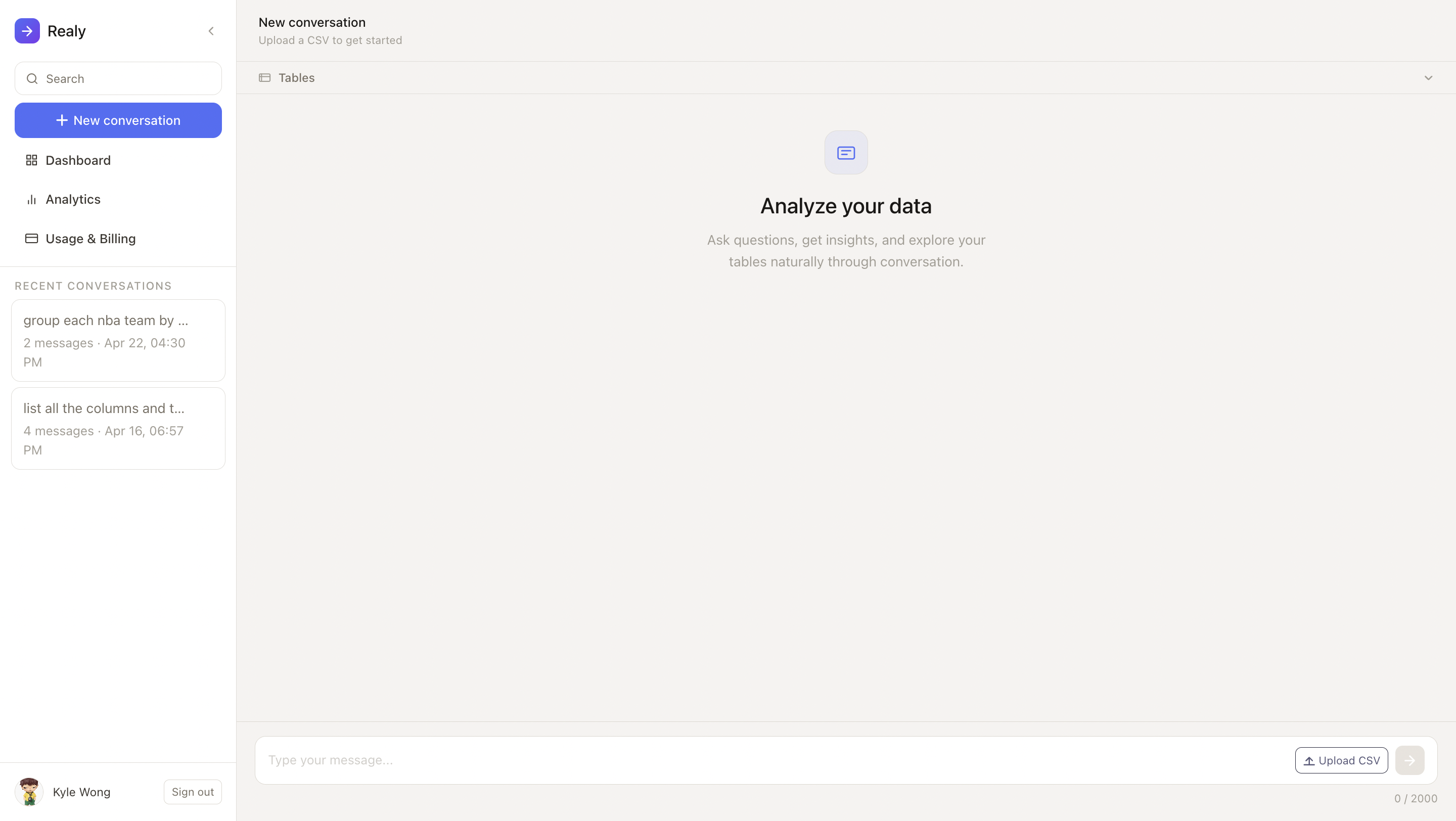
A conversational multi-table analysis workspace that keeps source tables, transformations, and results inspectable.
My contribution
Contributed to the web workspace, mobile interaction, streamed tool rendering, result-table binding, conversation-scoped edits, and synthetic demo validation. Realy is a team project from the UCLA Trustworthy AI Lab.
Technical approach
Expose source and derived tables alongside analysis steps. Keep edits and result bindings scoped to the correct conversation, and verify multi-table workflows with clearly synthetic data.
What the work demonstrates
- CSV upload and conversational multi-table exploration
- Visible tool steps and source-to-result table progression
- Frontend regression coverage for mobile, streaming, and table binding
Team attribution: UCLA Trustworthy AI Lab. This page describes my contributions rather than sole ownership of the system. Synthetic demonstrations do not establish clinical efficacy or regulatory readiness.
Visit Realy ↗Generative AI for Nano-Optics
Can a conditional generative model propose useful optical designs across wavelength and steering-angle targets?
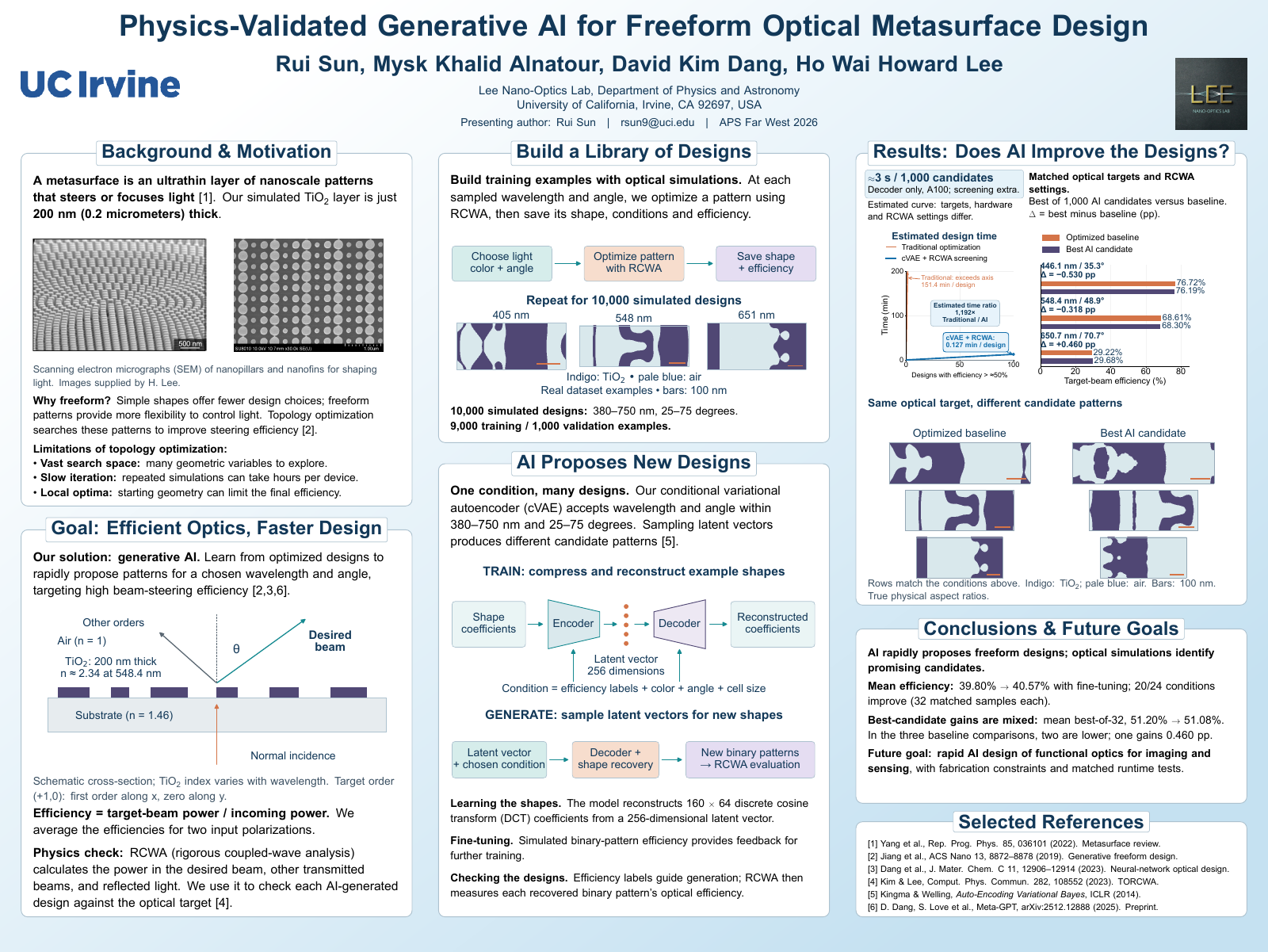
Conditional generation of freeform optical patterns, evaluated with electromagnetic simulation rather than visual similarity alone.
My contribution
Worked on simulation-data workflows, conditional VAE modeling, binary-pattern recovery, and RCWA-based evaluation at the UC Irvine Lee Nano-Optics Lab. The poster credits Rui Sun, Mysk Khalid Alnatour, David Kim Dang, and Ho Wai Howard Lee.
Technical approach
Learn 160 × 64 DCT coefficients with a 256-dimensional latent representation, generate candidates conditioned on optical targets, then evaluate recovered binary geometries with RCWA.
What the work demonstrates
- Poster dataset: 10,000 simulated designs; 9,000 training / 1,000 validation
- Wavelengths 380–750 nm; steering angles 25–75°
- Fine-tuning: mean efficiency 39.80% → 40.57%; 20/24 conditions improve
Simulation evidence, not fabricated-device measurements. Mean best-of-32 changes from 51.20% to 51.08%, so average improvement does not imply stronger best candidates. Runtime comparisons in the poster are estimates under differing conditions.
Read research & poster ↗Let’s talk
Interested in the work behind the interface?
I’m open to data science and applied AI opportunities, research collaborations, and technical conversations.
Contact Ricky ↗